
Twenty Years of Meditation: What Changed (And What Didn't)
After 20 years of meditation and 7 in a spiritual organization, here's what actually changed - and what didn't. No transformation story. Just honest inventory.

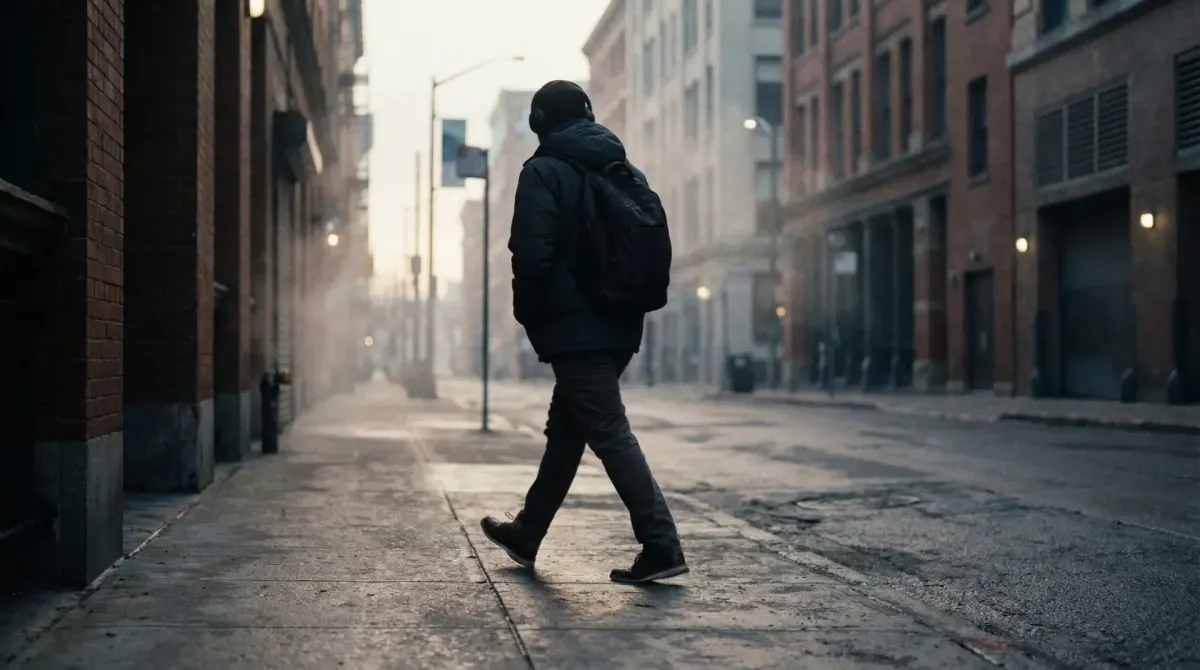
A month after returning from the ashram, I was walking to work.
Headphones in, music playing, mind already organizing the day's tasks: emails to answer, meetings to survive, deadlines to dodge. Somewhere between the second traffic light and the office door, it hit me.
A friend had warned me the day I came back. "Don't slip back into your house slippers too fast," she said. The meaning was clear: don't fall back into old patterns. Try to hold onto what you received there.
I'd laughed, politely but dismissively. "I can't possibly go back to what I was," I told her. "I feel so naturally changed. The shift is real."
One month later, I was practically running to the office, writing less, meditating almost never, and preparing to be "productive" instead of present. The rigorous practice from the ashram was already a memory. The person I'd been there, the one who woke before dawn and sat four times a day, had quietly packed his bags and left.
My friend had been right.
And in that moment, walking on autopilot toward another day of being useful to someone else's priorities, I made a decision that would shape the next two decades of practice: I would do what was possible in everyday life. Not what sounded impressive at retreats. Not what earned admiration from people who counted meditation hours like investment portfolios.
Just what could survive contact with reality.
The Promise That Keeps Moving
The part I only learned by doing it: the goal keeps shifting.
In the early years, I believed there was always "one more step." One more technique to master. One more level of understanding to reach. One more veil to lift, after which everything would finally be different.
This chase lasted longer than I'd like to admit.
I wasn't after calm, exactly. Or the ability to sit motionless for hours. It was something harder to name: a sense that subtle things would reveal themselves. That knowledge would somehow become complete. That "self-realization" (whatever that means; has anyone ever explained it?) was the destination, and once I arrived there, everything would fall into place.
I constructed this image myself, with help: the books I read, the people around me whom I considered "further along." And one teacher in particular, someone with an extraordinary ability to captivate attention, to make you believe the next corner held the answer. I trusted him. Not blindly; there were always small reservations. But enough to follow his pointing finger instead of looking where he pointed.
Then, halfway through my time in the system, that teacher was replaced.
The transition wasn't dramatic. No scandal, no departure speech. The organization simply continued with a younger guide at the helm. Different style, different approach, different presence.
I tried to bring him into my heart the way I had the first one. I told myself I needed more time. I waited for the internal shift to happen naturally, the way it had before.
It didn't.
A year passed, and I kept practicing, kept showing up, but something had changed, and it wasn't just the teacher. I started noticing things I'd either missed before or hadn't wanted to see: small inconsistencies, dynamics I'd explained away. A growing gap between what I expected from a spiritual path and what I was experiencing.
Whether the change of guides caused this or I would have arrived at the same conclusions regardless, I can't say with certainty. What I can say is this: I stopped trying to force the relationship. I stopped fighting to feel what I thought I should feel. The new guide became, in my mind, less a spiritual mentor and more like the CEO of an organization I still happened to belong to. Nothing personal against him. Just an honest recognition that guides don't transfer like property deeds simply because a system evolves.
And if the relationship wasn't transferable, then maybe what I'd attributed to the teacher had been mine all along.
Maybe I was the foundation.
Not in some grandiose way. Simply: whatever framework I adopted, whatever teacher I followed, I was the one who had to verify, integrate, and live it. No one could do that for me. And no amount of hours on the cushion could substitute for that recognition.
Of course, before I understood this, I spent years measuring the wrong things entirely.
The Hour-Counting Olympics
In those days, instructors would gather at the ashram in larger numbers for intensive periods. Practitioners would come for individual sessions, one-on-one meditations that could last an hour each. On a busy day, you might give ten of these sessions. It was exhausting. It was also, in ways nobody admitted openly, competitive.
"Did you hear? He gave seven sessions today."
"Those three practitioners only want to sit with her. Can you imagine?"
A hierarchy emerged. Not officially sanctioned, but unmistakable. The most sought-after instructors were either the veterans, the popular ones, or the freshly returned from training, their spiritual glow still visible, their techniques still crisp. Everyone else either relaxed into obscurity or competed for the first category.
I watched this from both sides. I'd been the sought-after one. I'd also been the overlooked one. And because I'd already been through one spiritual system that turned out to be more cult than community, I recognized the pattern. The achievement treadmill doesn't disappear just because the metric changes from money to meditation hours. It just wears different clothes.
Devotion can be disguised ambition, and surrender can be strategic positioning. The dynamics that run every organization, the comparison, the status anxiety, the quiet competition, don't pause because the mission statement mentions enlightenment.
I got lucky. Having seen this movie before, I knew how it ended. So I stepped off the treadmill before it could carry me somewhere I didn't want to go.
What Changed (The Honest List)
After twenty-plus years of practice, I can verify the following from daily experience, not what I believe changed, not what sounds good in a bio, but what I can point to.
I was never particularly reactive to begin with. But now there's a consistent filter before I speak, decide, or conclude. A small checkpoint that wasn't there at twenty-five: Is this useful? Does this affect someone unnecessarily? It's neither dramatic nor enlightened. It's just slightly more considered, and it happens without effort.
Given my current circumstances, I have plenty of reasons to be anxious. I'm not. Or rather, the anxiety doesn't stick the way it used to. I've become more realistic about the gap between what I think I deserve and what I have. And I've stopped looking for someone to blame for that gap. It's just life, doing what life does. This feels less like resignation and more like the absence of a war I didn't know I was fighting.
I used to be a people-pleaser. Decisions came from wanting to keep everyone comfortable, especially myself. Now I give myself time: introspection, weighing, sitting with it. And when the decision comes, it's often more final than it would have been at thirty. I can say "done" and mean it. Walk through a door without writing a manual for the people I'm leaving behind. This capacity was not available to me two decades ago.
If there's one tangible result from all those hours on the cushion, it might be this: I default to watching rather than joining. Psychologists call this "decentering", the ability to observe your own mental processes as events rather than getting fused with them.1 I don't need to pick a side immediately. The observer position isn't neutrality; it's just a half-second pause before engagement, and that pause has become my home base.
What Didn't Change (The Uncomfortable List)
What still surprises me after all these years:
I still procrastinate. Important things, obvious things, things I know I should do, and I put them off. Then I put off thinking about why I put them off.
I still reach for my phone as an escape hatch. The moment boredom or discomfort appears, my hand moves toward the device. Twenty years of training the mind, and the reflex is still there. Slightly slower, maybe, but there.
And then there's the one I'm almost embarrassed to admit.
I still build entire worlds in my head. It usually starts with a thought: someone said something, or might say something, or I imagine them saying something. That thought becomes a response. The response becomes a dialogue. The dialogue becomes an episode. Before I know it, I'm three seasons into a mental television series starring me and someone I may never have this conversation with.
The production values are impressive, the scripts elaborate, the emotional investment embarrassingly real. And none of it exists outside my skull.
Neuroscientists call this "mental time travel", the brain's tendency to simulate possible futures and rehearse imagined scenarios.2 It's deeply wired. You'd think thousands of hours of watching thoughts would cure it. Meditation is supposed to create distance from mental fabrications, right? You observe the thought, you don't follow it, you return to presence.
In theory.
In practice, I've gotten better at noticing when I'm six episodes deep into a fictional drama. But the noticing doesn't always come quickly. Sometimes I catch myself mid-season, fully invested in an argument that will never happen, defending positions that were never attacked, convincing people who aren't in the room.
The good news: I recognize the pattern now. The moment I see what I'm doing, the series gets cancelled. No renewal. The bad news: the pilot episodes still get greenlit more often than I'd like.
Twenty years of practice hasn't eliminated this. It's just given me a slightly faster cancellation reflex.
The Minimum That Works
So if intensive practice doesn't survive contact with real life, and the hour-counting Olympics lead nowhere, what's left?
A formula I arrived at through trial and error:
Consistency multiplied by honesty beats duration multiplied by ego.
Most conversations about practice focus on the first part: how often, how long, how to build the habit. I've written about the mechanics in more detail here, and they matter. But the part that usually goes unexamined is "honesty," and it might be the only part that counts.
Honesty means asking: who am I practicing for?
There's a version of practice that's essentially a performance. You sit because you told someone you would. You meditate because it's part of your identity now, and identities need maintenance. You log the minutes because the app gives you a streak, and streaks feel like progress. None of this is wrong, exactly. But it's not honest.
Honest practice is what happens when nobody's watching and nothing's scheduled. It's showing up on the days when you'd rather not, without an audience to validate the effort. It's admitting that today's session was garbage, that your mind was everywhere except here, that you spent twenty minutes planning dinner and calling it meditation.
The ego version of practice chases duration. More minutes, deeper states, longer retreats. It looks impressive on paper. It also tends to collapse the moment life gets complicated, because it was never about practice. It was about achievement wearing meditation clothes.
The honest version chases something smaller: did I show up today? Not perfectly or impressively. Just: was I there?
Yes, this is a lower bar. Lower bars are the ones you clear.
The high bar, the ambitious practice, the impressive hours: they work beautifully in controlled environments: retreats, sabbaticals, periods when life cooperates. But life doesn't cooperate most of the time. And a practice that only works when conditions are perfect is a hobby, not a practice.
I've learned to distrust the voice that says "more is better." That voice got me into trouble before. It confused effort with transformation and hours with depth. What I trust now is consistency, the unsexy kind that doesn't photograph well but survives contact with real life.
The View From Here
At thirty, I thought of spiritual practice as a project with a destination. There were stages to pass through, levels to attain, insights to collect. Somewhere ahead was an arrival point where things would finally make sense.
At fifty, I know there is no arrival point. And more importantly, I've stopped wanting one.
This is something stranger than resignation: the realization that not knowing is the final position, not a temporary inconvenience on the way to certainty.
In the early years, every dead end came with a pre-packaged explanation. "It's karma." "It was meant to be." "The universe has a plan." These phrases felt like wisdom at the time. Now I recognize them for what they are: spiritual marketing designed to fill the gap where honest uncertainty should live. They're the "terms and conditions" of the self-help industry: nobody reads them, but everyone clicks "accept" because the alternative is sitting with the discomfort of not knowing.
I don't click accept anymore.
The FOMO has disappeared too. Spiritual FOMO, the fear that someone else has found the answer you're still searching for, that some teacher or technique or tradition holds the key you're missing. This fear is the engine of the entire self-help economy. It keeps you searching, buying, consuming. It makes you a permanent customer.
Somewhere along the way, I stopped being a customer. Not because I found what I was looking for, but because I stopped believing the search had a destination. The truth, if there is one, doesn't come beautifully packaged. And if it's not packaged beautifully, most people don't want it. The search for arrival was just another terms and conditions I stopped signing.
If I could talk to the thirty-year-old version of myself, I'd say: pay more attention to yourself. Not in the self-help sense, not in the spiritual sense. Just the practical sense: you were pouring everything outward and calling it virtue. It wasn't. It was a way of not having to be home.
But honestly: if I could change his mind, I wouldn't be who I am now. The mistakes were the curriculum. I'm not sure I'd want to edit them out, even if I could.
What remains, after the FOMO fades and the marketing stops working, is something simpler: the project is with yourself. Not with the system, the teacher, or the community. Those can be supports, scaffolding, context. But the actual work happens inside, and nobody else can do it for you.
The work you do on yourself does seem to affect how you function with others. Not through any cosmic mechanism, but because you stop grinding against everything around you.
The project, it turns out, was never the one I signed up for. It was smaller and less photogenic and, somehow, more useful.
What It Gives You
I should be clear about what twenty years of meditation won't do.
It won't give you calm on demand, patience on tap, or parking spots on request. It won't make you immune to being human.
What it might give you (and I say "might" because nothing is universal) is a slightly better-calibrated nervous system. The ability to respond instead of react, sometimes. A half-second gap between stimulus and behavior where a choice can happen.
You notice when you're not calm a little bit faster than you used to. That's the whole offering after two decades.
What surprised me most: it's enough. Not because I lowered my expectations, but because I finally understood what expectations were for.
The rigorous practice from the ashram wasn't possible to replicate at home because the ashram wasn't normal life; it was a greenhouse: perfect conditions, controlled temperature, someone else cooking your meals, no inbox, no deadlines, no relationships requiring attention. Research confirms what I learned the hard way: the frequency and quality of home practice predicts outcomes better than retreat intensity.3
Real practice happens in the wild. In the walk to work. In the five minutes between meetings. In the chaos of a regular Tuesday when nothing is scheduled and nothing is sacred.
If you can practice there, you can practice anywhere.
If you can only practice in the greenhouse, you're not practicing. You're vacationing.
Frequently Asked Questions About Twenty Years of Meditation
What does twenty years of meditation teach you?
That you are the foundation, not the teacher, not the technique, not the tradition. Every practice is scaffolding, useful and sometimes essential but temporary. The building is you. Twenty years of practice, including seven in a cult-like organization, clarified one thing above all: what works has to be verified in your own direct experience.
Can you practice meditation incorrectly for years?
Yes. I spent seven years in a community that mistook surrender for wisdom and trust for discernment. I was meditating daily the whole time. The practice wasn't the problem, the framework around it was. Good technique inside a bad container can slow growth instead of accelerating it.
Is long-term meditation worth it?
It depends entirely on what you're optimizing for. If you want peak experiences, probably not the most efficient path. If you want to gradually become someone who reacts less, sees more clearly, and is harder to manipulate, including by your own stories, then yes. The returns are slow, unimpressive, and real.
What is the biggest mistake people make in spiritual practice?
Outsourcing verification. Trusting the teacher, the system, or the community to tell you what's true instead of testing it against your own direct experience. Good teachers explicitly ask you to verify everything. The ones who don't, or whose followers forget to, are where things go wrong, regardless of how legitimate the tradition is.
Continue Exploring
The Seven Years — What I learned from spending seven years in a spiritual organization before I understood what I was in.
The Minimum Viable Spiritual Practice — The mechanics of a practice that survives real life: the routine, the rules, the non-negotiables.
For You
A micro-experiment for the next week:
Each morning after you practice (or after your coffee if you don't), write one sentence, just one. Not a reflection, not an insight, just a single observation about what you noticed, or what you avoided noticing.
Keep these sentences somewhere visible. Your phone's notes app, a sticky note on your desk, a dedicated page in a notebook.
At the end of seven days, read them in sequence.
The experiment isn't about the sentences. It's about what you notice when you try to capture something that usually evaporates the moment practice ends. You're not building a greenhouse. You're training yourself to pay attention in the wild.
Writing to Think, Not to Perform
The search for the perfect practice might be the thing keeping you from the practice you actually need.
I send one email every week. Usually on Tuesday. Always something you can test, not just think about. The search for the perfect practice usually ends at a person. 7 Questions Before Following Any Teacher, free, and one essay most Tuesdays.
One email a week. Unsubscribe anytime.
Already subscribed? Share this with someone else.
Notes & References
- Bernstein, A., et al. (2015) . "Decentering and Related Constructs: A Critical Review and Metacognitive Processes Model." Perspectives on Psychological Science , 10(5), 599-617. ↩
- Schacter, D.L., et al. (2007) . "Remembering the past to imagine the future: the prospective brain." Nature Reviews Neuroscience , 8(9), 657-661. ↩
- Crane, C., et al. (2014) . "Practice quality, not quantity, predicts outcome in mindfulness-based cognitive therapy." Behaviour Research and Therapy , 62, 50-59. ↩