
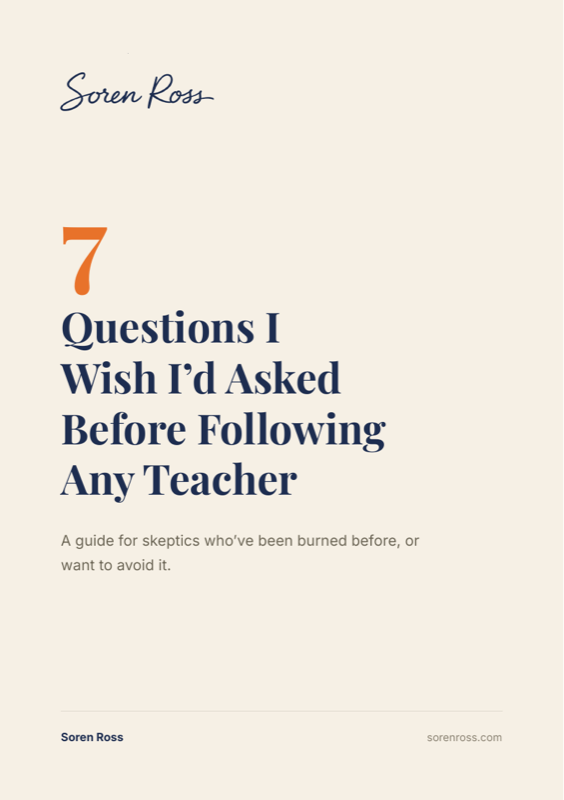
7 Questions I Wish I’d Asked Before Following Any Teacher
A free guide for skeptics who’ve been burned before, or want to avoid it.
I knew something was off for more than six months before I left the spiritual organization I’d given seven years to. What kept me there wasn’t faith. I’d absorbed, carefully and kindly, the idea that there was nothing outside the system: no other path, no honest life without it. So I stayed, not because I still believed, but because I couldn’t picture leaving.
Nobody recruited me with dark robes and obvious lies. I joined at twenty because I was hungry for meaning and someone seemed to have answers. The people were mostly kind. The experience was often beautiful. That’s what makes the question hard: I was looking away from small things, not monsters, the kind I’d now tell someone I love to take seriously.
Leaving took months and, in the end, a bit of geography: the organization sent me to another city, and from that distance the shape of the thing was hard to unsee. I never went back. Understanding took longer, the better part of three decades, and it condensed to something you can read in five minutes: seven questions that, asked early, would have kept me awake through the whole thing. I wrote them down, with the red flags and green flags I learned for each, so they’d exist somewhere outside my head.
Those decades gave me a control group. A second tradition, one that welcomed questions this time. Years of practice with my eyes open. Eventually a stretch as an instructor, sitting with hundreds of people and hearing where their doubts snagged. The seven questions survived all of it. If anything, teaching made them sharper.
So who am I to hand out questions about teachers? Nobody in particular, which is the point. I’m not a teacher looking for students, and I keep my face off this site on purpose: the questions have to stand without a personality attached. I’ve met teachers worth trusting. I’ve also met people who were very skilled at looking trustworthy. Learning to tell the difference cost me years. You can have the short version for an email address.
The Seven Questions
Three or more red flags is not proof of a problem, but it is a reason to pay closer attention.
FROM THE GUIDE · PAGE 4 OF 13
2. What happens to people who leave?
How does the community talk about former members? The story a group tells about those who leave reveals what they believe about loyalty, growth, and individual choice.
Former members are pitied, criticized, or quietly explained away.
People leave with their dignity and their relationships intact.
“When the leaving itself has to be explained as someone’s failure, that tells you more about the system than about the person who left.”
Question 2 of 7. The other six are in the guide. Get it below ↓
Who It’s For
Questioning a teacher or a group right now
The questions give you language for what you’ve been noticing.
Already left, still sorting it out
A way to name what happened without turning bitter.
Starting fresh, eyes open
What to check before you commit to anything new.
What You Get (and What I Get)
You get the guide, free, plus one essay most Tuesdays on practical discernment: what works, what doesn’t, and how to tell the difference. In the first few weeks that means the story of the cult I didn’t recognize as a cult, what verifying everything looks like in practice, and one experiment you can run in a single week.
What do I get? A reader. That’s the whole model: no ads, no sponsors, nothing for sale on this page. If that ever changes, you’ll hear it from me plainly, not through a countdown timer.
And if it’s not for you, unsubscribe works on the first try. I won’t take it personally.
What Happens Next
Enter your email and confirm it. One click in your inbox.
You land back here signed in, and the guide opens in your browser. Yours to keep.
You’re also on the Tuesday list: an essay most weeks. Leave anytime.
Already confirmed your email? Open your guide →