Am I Too Comfortable Alone?
The list of freedoms was supposed to be a celebration. It cracked under my own hand at item eight.

Getting good at being alone comes with a suspicion built in: past a certain point, you can no longer tell whether you have healed or just fortified. The suspicion caught up with me on an ordinary Saturday evening, tired in the good way, after a day spent fixing the heating in my apartment with my own hands. I sat down to take stock, the way I do when a day has gone well, and the stocktaking turned on me halfway through.
The list was supposed to be a celebration. I have gotten used to this comfort of being alone, I wrote, and I lined up the evidence: making decisions by myself, staying where I want for as long as I want, spending or saving without a meeting, sleeping alone in a big bed, not caring much how I look, or how to make myself pleasant, listening to music alone, walking without a destination alone. Eight items in all, and somewhere between the seventh and the period that should have closed the eighth, my hand added a parenthesis I had not planned: this would be nicer with someone, though, not alone, of course.
I caught it while I was still writing it. The next line came out already changed: a relationship means sharing, and it seems I have gotten used to the version without it. I had not thought about that until now, when the question is no longer theoretical.
The parenthesis skipped the money and the bed and the decisions. Seven of those items are administration, the quiet paperwork of a life run by one person. And the paperwork is pleasant. It interrupted at the walk, the only entry on the list you live through rather than manage. Whatever wrote it sat politely through the whole administrative section and voted at the first item that was an experience.
If you arrived here by typing "am I too comfortable being alone" into a search engine, that parenthesis is my version of your question, and I should say upfront that I do not have the verdict. What I have is what I tried, and where the trying stopped working.
Comfortable Alone or Avoiding Intimacy?
The obvious move was to settle it on paper, since paper is where it surfaced. The list itself had been the defense's opening statement: look at the freedoms, the decisions, the unshared bed, the walking. It was doing fine until it produced, mid-sentence, an exhibit against its own case. Even then nothing was settled, because what does one parenthesis prove against eight items? Maybe the eight are the truth and the parenthesis is a stray mood. Or the parenthesis is the only honest line on the page, and the eight are alibis.
I even had literature on my side. Long and Averill distinguished solitude from loneliness and counted freedom among the benefits of the chosen kind.1 My list was chosen, every item on it. The trouble is that chosen is exactly what a barricade would be too. Their distinction separates solitude from loneliness, and I was asking a question their paper never set out to answer.
So I searched the archive instead. Three and a half decades of journals contain evidence for both verdicts, properly documented. There was the year I lived alone in another city: yoga, one meal a day, long walks by a lake, ten kilos lighter, and a note in the journal saying it might have been fine to simply continue like that. And there was the stretch right after the marriage ended, when I could not stand the quiet and filled it with the nearest familiar presence, against every plan I had written for myself. The past will testify for whichever side calls it. You find exactly the verdict you go looking for, which means you find none.
Then I tried settling it by decision. Earlier this summer I put it in writing, rationally: I am open, and the next real invitation gets a real yes. On the surface it held. I showed up and stayed, asked decent questions, repaired my small mistakes as I made them. Underneath, a clerk kept filing objections: why am I doing all this, I could be home, at peace. You can be open as conduct, apparently, and have no idea whether you are open as a state.
I took the question to someone I pay to listen. What came back was a reframe I liked: you come from comfort, not from hunger, and a man who comes from comfort can choose instead of grab. I still like it, but a frame is not a reading. It changed how the question sat with me, not whether I could answer it, and by the next morning it was back, just better dressed.
Even meditation returns nothing usable here, and that is the instrument I have trusted longest, after twenty years of watching my own mind. It can show me, in detail, what today's solitude feels like. It has nothing to say about how tomorrow's un-solitude would feel, and that is where the question lives.
What took me longer to see was the limit they shared. The pleading, the archive, the decision, the counselor, the cushion: they disagree about everything except the one thing none of them can do, which is produce the counterfactual. Everything I have tried reads the life I have. The question is about a life I do not have, and nobody sells an instrument for that.
The Walk, Audited
I should be honest about item eight, since everything pivots on it. The walk without a destination has a fixed route and a daily quota of ten thousand steps. I like knowing how long freedom takes. There are headphones involved, usually a podcast I retain nothing from, kept around for the company of voices, and under it music, which is with me always, at home, at work, at the shops.
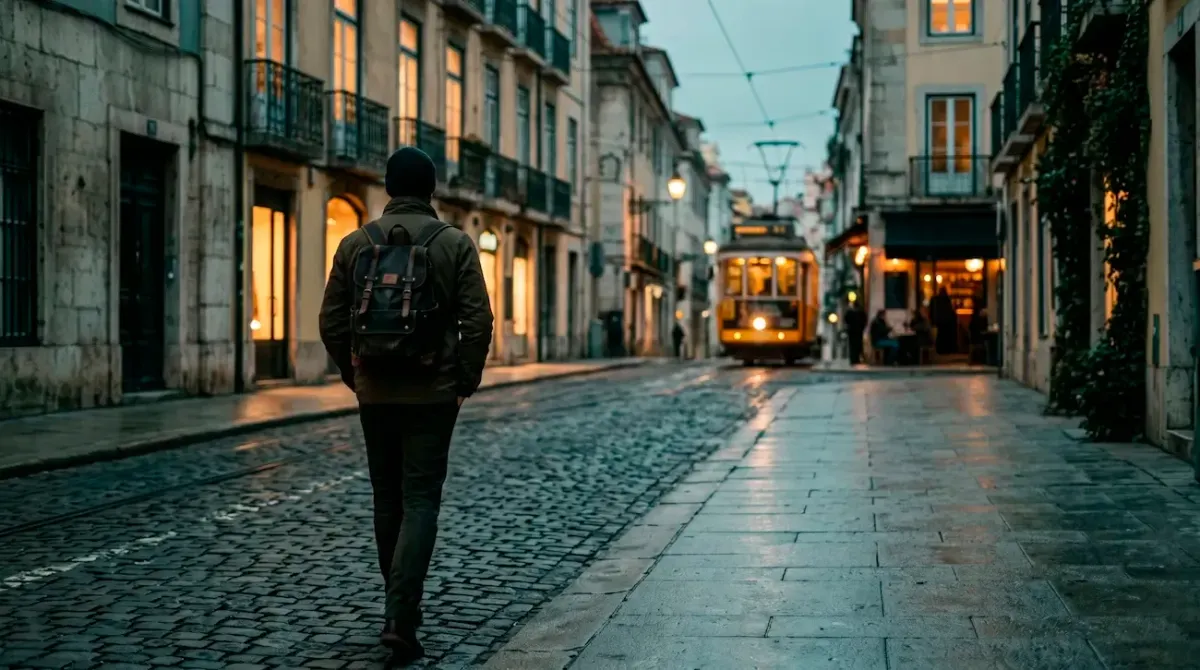
The quota is not what the walk is for, though. The walk is how I see. Cobblestones, trams, scribbles on walls, flowers in somebody's window, dogs pulling on leashes, notices pinned to boards by people who still believe in notices. Mostly faces. I read the faces of strangers and write them little biographies: why does he look worried, the coat is not helping, that is the walk of a man carrying something heavy with no weight to it. On the tram I do the same in fast-forward, discreetly, because there is a line between an observer and a creep and I intend to stay on the right side of it. I have built whole people out of less, but that is a different essay.
Every one of those biographies is composed for an audience that does not exist. That is what the parenthesis knew before I did. The movies advertise hand-holding; what I would actually want is the commentary finally having somewhere to go. Look at that. Did you see him? What do you think her story is?
There was one experiment I did not design. Not long ago I walked with someone, an actual person next to me, and for the first time in a long while the walk itself held no interest. I could not tell you what we passed; the conversation had taken the seat the seeing usually occupies. The catalog stayed shut, and I only noticed afterward, at home, the same habit that started all this turning up nothing to inventory. I still keep the data point.
What I Still Don't Know
It is mid-August, and I catch myself holding a belief: a walk with someone I actually wanted beside me would need no catalog at all, because we would be too busy being together. That is a confident description of a life I have never lived, manufactured at the same desk that produced the list, and I have already watched one confident document from that desk crack in real time. I could not command my availability in July and I cannot command it now. At most, I am willing to find out.
I keep trying to see the difference between a foundation and a barricade from the inside. I have not managed it yet. Both of them feel like solid ground and come with a list. I have built a life good enough that nothing appears to be missing, and "appears" is doing quiet work in that sentence. My instruments all agree with me, which is either reassurance or the whole problem.
Keep Exploring
Related, if the parenthesis felt familiar:
- The Person I Was Talking To Didn't Exist — on building a whole relationship with someone who was mostly my own construction.
- Emotional Intelligence at 51 — how the comfortable single life got built in the first place, and what it took to start noticing.
Worth Pointing At
The parenthesis ran its test on me without permission. Yours might show up on a walk, a tram ride, or somewhere else you notice the world.
When was the last time you saw something worth pointing at, and realized there was no one to point it to?
Questions for lists that sound certain
This essay was five instruments failing to answer one question. Years ago I wrote seven questions for testing voices that sound certain; they work on inner juries too. 7 Questions Before Following Any Teacher, free, and one essay most Tuesdays.
One email a week. Unsubscribe anytime.
Already subscribed? Forward it to someone who takes their aimless walks on a fixed route.
Notes & References
- Long, C. R., & Averill, J. R. (2003) — "Solitude: An Exploration of Benefits of Being Alone." Journal for the Theory of Social Behaviour, 33(1), 21–44. ↩
Frequently asked questions
Can you be too comfortable being alone?
Maybe, but comfort alone will not tell you. A settled solo life and a quiet barricade feel identical from the inside: both are pleasant, both come with a list of reasons. I could not sort mine from the inside. The only thing that told me anything was contact with an actual person, not more thinking about it.
What is the difference between enjoying solitude and avoiding intimacy?
On paper, one is chosen and one is fear. In practice, avoidance is also chosen, and it looks exactly like a preference. I stopped trying to name which was which and watched what happened when someone was actually there. The behavior in the room told me more than any label I could apply alone.
Does being comfortable alone mean I am avoidant?
Not necessarily, and a quiz will not settle it either. Plenty of people are content alone and perfectly able to let someone in. The honest answer is that you cannot read it off your own contentment. It shows up in contact, not in introspection, which is inconvenient but seems to be how it works.
Why do I prefer being alone after a long relationship?
Because you rebuilt a life that runs, and a life that runs is genuinely good. The freedoms are real. What I found is that the same freedoms can be a foundation or a wall, and rebuilding does not tell you which one you poured. That question tends to stay open until someone stands at the edge of it.
Can you be too independent for a relationship?
You can get so good at needing nothing that intimacy has nowhere to enter. I do not think that is permanent, and I am not sure it is even true of me. Being able to do everything alone and wanting to are different things, and only one of them is a wall.