I Gave Up a Relationship for a Spiritual Path. Except I Never Chose To.
The last time I saw her, we were both passengers. Twenty-six years later, a film scene and a regret study helped me name what happened at that roundabout.

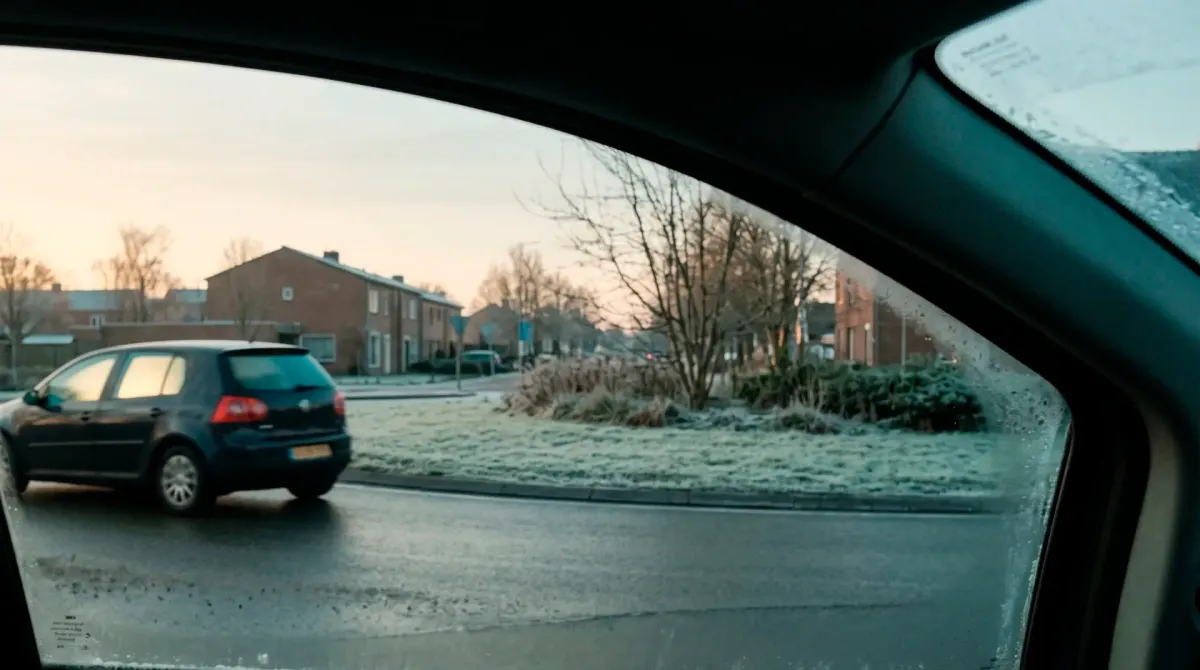
The last time I saw her, we were both passengers.
Two cars leaving the same event, the first days of January, winter light still low over the road. At the roundabout her car went one way and mine went the other, and for a moment the geometry cooperated: I was in the front seat beside one driver, she was in the back seat behind the other, and the diagonal between us held for about as long as a roundabout takes. We looked at each other through two panes of glass. Then both cars finished their turns.
Neither of us was driving.
The scene is twenty-six years old, and I liked her, which is exactly the combination that makes a witness unreliable. Maybe it didn't happen quite that way. It's how I've carried it. Memory, for what it's worth, is generous with this scene: it will supply the colors of the cars, the makes if I push. The only detail I actually trust is the seating chart.
A month, maybe less
People who gave up a relationship for a spiritual path usually remember deciding. I remember finding out. The honest place to start is the size of the thing.
We had known each other for a month. Maybe less. Same event, same crowd, the kind of proximity that does the work introductions are supposed to do. We were not a couple. Nothing had been said and nothing planned, by either of us; it was early, and the attraction was obvious to everyone around us before either of us knew what to call it.
I've built a relationship entirely in my head before, and written that story. This was different: real, seemingly mutual as far as a month can tell, and witnessed, it turned out, by the one man in the room trained to notice everything.
What I liked most was how she looked at things. I'm aware the roundabout may have promoted that look after the fact, iconic because it turned out to be the last one. I'll flag my bias and keep the look anyway.
So no, I'm not going to tell you I sacrificed the love of my life. I'd be tempted to write that version: I follow her out of the roundabout, we marry, we grow old together. I can't. Nothing supports it. A month, a look, and a direction I didn't take. What that direction cost took me twenty-six years and one movie to name, and it is smaller than a marriage and much harder to close.
The applause
A day or two later, at the group's lodgings, the teacher held one of his evening meetings. Somewhere in the middle of it, he praised me.
I can't quote him. Twenty-six years have eaten the sentences and left me the meaning, which was roughly: look at what sacrifice looks like. He refused to follow love, for the sake of the work. This is what evolution costs.
The strangest part of that evening escaped me for twenty-five years: nobody knew about us. There was nothing to announce, and even we had never said a word about it to each other. He was the only person in that room who had seen it, assembled out of glances, seating patterns, the way two people laugh at the same delay. Later that evening a friend caught me in the corridor: "I didn't know about you and..." There had been nothing public to know. The praise was the first anyone had heard of us. Including, in a way, me.
The applause did not follow any choice I remembered making. It was how I found out that, apparently, I had made one. The renunciation he held up to the room had happened nowhere I could point to; I could find no conversation in which I had weighed her against the work, and no evening of doubt behind it. Yet he had seen the potential more clearly than I had, and his compliment was my first accurate look at it.
He congratulated me for refusing something nobody had offered me yet.
What I felt, under whatever my face did for the room, had nothing elevated in it: the specific embarrassment of learning, in public, that you have missed the plot of your own month. I don't trust praise; something always arrives with it. I also won't pretend there was no flattery in it. Some part of me probably sat a little straighter at being the example. The doubts were small that evening, and they were present, and I filed them where I filed everything back then.
I believed, sincerely, that I was on the shortcut. Evolution was the word, and the organization had a whole grammar for it: the work mattered, the world needed what we were doing, and the rest of a life happened in the margins, or didn't. In that grammar, her car was a subplot.
I don't think this needs a guru, either. Once he called it a sacrifice, my own memory was already rearranging itself around the word.
The scene I kept rewatching
A few years later, sometime between 2001 and 2004, I saw Good Will Hunting.
I have rewatched it more times than I can count, across twenty years, and for all of those years I had a theory about why: the mentorship, the wasted-genius arc, the therapy scenes that everyone quotes. The theory kept pointing at the wrong scene.
The scene that gets me is Sean, on his doorstep, reading the note. "Sorry, I had to go see about a girl": the line Sean himself had used a whole film earlier, telling the story of the night in 1975 when he skipped the most famous baseball game of his generation to have a drink with the stranger who became his wife. He tells that story proud. And now the kid has stolen his line and gone, and Sean reads it, and smiles, and says so, and the Elliott Smith song starts, and that, every time, is the moment my eyes give up.
It took me until this August to understand my own reaction, and the understanding arrived in writing, mid-sentence, while I was telling someone about my favorite film. I might love this movie because it is the story of my life in the version I didn't live, and what pulled me back each time was Sean's face, not Will's gesture. Somewhere in me, for twenty-six years, sat the scene where the man whose opinion mattered finds out I chose a person, and is glad about it.
I had the other version: same chair, same authority, a finding-out even sharper, since he found out before I did. What came back from that chair was a lesson plan.
Did I keep rewatching the missing decision on purpose? I don't know. These days I'm tempted to believe maybe yes. I haven't rewatched it since the realization; I'm saving that viewing, deliberately, the way you save a conversation you finally know how to have.
I eventually found one plausible explanation for why the file never closed. In the early nineties, Gilovich and Medvec pulled together the research on what people actually regret and found a pattern with a clock in it: fresh regrets tend to center on things we did, while over time the balance shifts toward things we didn't do.1 The way I read it on my own case: when you act, you end up with something to metabolize. A failure, an embarrassment, a divorce. You can grieve a thing that happened. The note I never sent produced no outcome at all, so there was nothing to finish. The file stayed open, and imagination kept it staffed. Their data describes a general pattern, not my roundabout; it just gives the durability a plausible mechanism. What I lost there couldn't have been a marriage, because no marriage existed to lose. The loss was the answer itself. And an answer you never got is the exact shape of thing a mind can keep for twenty-six years without it going stale.
One sentence
The note would have been one sentence long. "I'd like to see you again." That was ninety-nine percent of the note.
I knew her city. Back then I even knew how to reach her: a letter, a message passed through the crowd we shared, the ordinary next step that ordinary people take. It was not a hard note to write. And I didn't decide against writing it; that is the part I keep having to say precisely. The teaching was in everything by then, the way furniture is in a house, and from inside it, not writing didn't feel like discipline or like censorship, whatever I would call it now. It felt like the state of things. The sentence never formed.
Under that note sat a second one, and it stayed unwritten much longer: the whole story. In twenty-six years I have not told it to anyone in this shape. It lived where unsent things live. She surfaced from time to time across those years, never as a story, always as the look. She may be the only other person holding a version of this, and I have no idea what hers says, or whether it exists at all.
I stayed with the organization another nine months after that January. Then I left, in a different direction entirely; the leaving had its own reasons and its own story, and she wasn't among them.
Years later I looked for her and found nothing. No trace a search engine recognizes, which for her generation of the internet proves very little. She's probably a grandmother by now.
What's left, when I check honestly, is small and clean. I would like to know she's happy: family, health, the whole ordinary list. I have no wish to appear in her life, none. I'd just like to know the roundabout sent her somewhere good.
The mechanism that kept me quiet hasn't retired, by the way. I can still bury myself in work that feels important enough to eat the margins. So far, no second car.
And the look. I could still sit down and draw it, twenty-six years later. By now it would be a drawing of my imagination, and I'm keeping it anyway.
Keep Exploring
If this resonated, you might also find value in:
- How I Left a Spiritual Community Without Becoming Bitter — the mechanics of the actual exit, nine months after this story ends.
- The Person I Was Talking To Didn't Exist — what projection builds when a relationship lives mostly in your head, and how to take it apart.
Questions for a teaching that answers first
The note never got written because the teaching had already answered. Years later I wrote down the seven questions I wish I'd put to it before it started answering for me. 7 Questions Before Following Any Teacher, free, and one essay most Tuesdays.
One email a week. Unsubscribe anytime.
Already subscribed? Send it to someone with a one-sentence note they never sent.
Notes & References
- Gilovich, T., & Medvec, V. H. (1995) — "The Experience of Regret: What, When, and Why." Psychological Review, 102(2), 379–395. ↩
Questions people also ask
Can you regret a relationship that never happened?
Yes, and in my experience it can outlast the regret of things that did happen. A relationship that never started produces no outcome: nothing to grieve, nothing to be disappointed by, nothing to finish. What stays behind is the answer you never got, and an open question survives on imagination alone. Mine has held for twenty-six years.
Why do we regret the things we didn't do more than the things we did?
Gilovich and Medvec, reviewing the research on regret in the nineties, found a temporal pattern: fresh regrets tend to center on actions, while over time the balance shifts toward inactions. One plausible reading is that actions produce consequences you can process and close, while inactions leave nothing to process. The file simply stays open.
Can a spiritual path make you avoid relationships?
It can, though in my case "avoid" is too deliberate a word. Inside the organization I belonged to, the work was the point and the rest of life happened in the margins. I never weighed a relationship against the path and chose the path. The sentence that would have started the relationship simply never formed. That is quieter than avoidance, and harder to notice.
Should you give up a relationship for a spiritual path?
I can't answer that for anyone, and I would distrust anyone who answers it quickly. What I can offer is a narrower question that took me twenty-six years: whose choice is it, and who got to name it? If a teacher, a community, or a doctrine has already decided what the right decision means, it may not be your decision at all, not even when you are being praised for it.
Why do people stay attached to a "what if" for decades?
Partly because a what-if never ages: no outcome arrives to correct it. And partly, at least in my case, because it found reinforcement. A film I loved kept replaying the version I didn't live, and for twenty years I told myself I was rewatching it for the mentorship scenes. Attachment to a counterfactual is rarely idle; it usually has a job.