

Trail· The Minimum Viable Spiritual Practice
Spirituality Without Religion: How to Practice It
What to practice without a religion, how to start small, and how to tell a habit worth keeping from one you only defend.
5 layers11 essays~1.6 h of reading
On this trail · 8 sections
- 1. What does "spiritual but not religious" actually mean?
- 2. What do I actually practice, and how do I start?
- 3. What if it doesn't seem to work?
- 4. What do I keep when the belief behind it is gone?
- 5. Who checks my practice when there's no institution?
- Where to start
- The Minimum Viable Spiritual Practice, layer by layer
- Questions this trail answers
Spirituality without religion is an inner practice you keep without a religious institution keeping it for you. Some people arrive here after leaving a religion; others never belonged to one and want a practice anyway. Either way, the same three jobs land on you that a religion would otherwise do: deciding what to practice, carrying it through ordinary weeks when you'd rather skip it, and judging whether it's helping. This page is a map of how to do those three jobs yourself, with help where help is useful.
The approach I've ended up with has a plain name: the minimum viable spiritual practice, the smallest practice that still makes a difference you can describe in an ordinary week. I didn't start there. I spent seven years in an organization I'd now call cult-like, then twenty-some years in a second tradition, and I've meditated for most of the thirty years in between. Much of what follows I learned by doing the opposite first. You don't need to settle whether you believe in God before trying any of it.
1. What does "spiritual but not religious" actually mean?
It's mostly a self-description. In Pew's 2023 survey, about 22 percent of American adults said they think of themselves as spiritual, or consider spirituality very important, without thinking of themselves as religious. Close to half of them still identify with a religion, so the label describes a relationship to belief more than a membership card. I've written a field guide to the label for people who dislike both of its words; it's the place to go if you're still deciding whether the phrase fits you at all.
The word "spiritual" carries a second trap. Once part of your life is spiritual, the rest quietly becomes something else: the Sunday meditation feels sacred, the Friday argument with a colleague feels like noise. There may be no separate spiritual life, only a life with some hours you've decided to pay attention to. It changes where you look for the effects of a practice, which matters in section 5.
2. What do I actually practice, and how do I start?
Start smaller than you think you should. Pick one simple thing, a time of day you can actually keep, and one change you'd like to notice outside the practice itself: how fast you catch your own irritation, say, or how you come back after a bad conversation. Ten minutes kept for a month will tell you more than an hour you abandon in a week.
For many people that one thing is sitting still. Stripped of the incense, meditation is the practice of noticing where your attention went and bringing it back. Start there if you tried meditation once and hated it. It doesn't have to be the cushion, though. Paying deliberate attention during something you already do (a walk, the dishes, the first minutes of a conversation) uses the same muscle.
My own practice is about thirty minutes a day now, down from two hours for years. The minimum viable spiritual practice explains why less, kept regularly, did more for me than more, kept anxiously. Thirty minutes is my number after three decades, not a threshold for you. And not every practice earns its place: I kept journals for thirty years, and most of the three boxes turned out to be thinking in circles with better handwriting. Read it before you add a practice just because everyone recommends it.
3. What if it doesn't seem to work?
It helps to separate two questions. One is whether today's session was any good. The other is whether the habit belongs in your life. The first question is mostly noise. For about ten years I sat at six in the morning treating every session as a deposit toward something higher, and the counter in my head made every restless morning feel like a loss. The days when meditation feels like nothing are still practice, and the essay is mostly about dropping the scoreboard.
The second question deserves an honest answer every so often: does keeping this habit help in ways I can describe, at a cost I'm willing to keep paying? Look past the session itself, at the ordinary week around it. The answer can be mixed, and a hard month can blur it. That's a reason to look again, without automatically defending the practice and without adding more time to it. When the answer kept coming back empty for me, the cause was a list of promises I'd absorbed before I started; when meditation isn't working is the essay about taking that list apart, whether it came from a tradition or an app.
4. What do I keep when the belief behind it is gone?
If you came from a religion, you'll probably meet this one. You still do the practice, and the belief that used to explain it has quietly stopped. You're usually offered two doors: argue yourself back into the belief, or throw out the practice with it. Both assume the practice and the belief are a single object. Keeping the practice and cutting the claim is the third door, and that essay is about how to stay honest while you use it.
The same cut works on experiences. For thirty years I was certain I could feel chi, first in a cold martial-arts gym and later on the cushion. I still feel the warmth, and I no longer let it prove the explanation that came with it. You can keep what you feel without asking it to carry more than it does.
5. Who checks my practice when there's no institution?
The decision stays yours, and the checking doesn't have to be done alone. Without a church, it's tempting to hand the whole judgment to the next teacher, app or framework, and just as tempting to trust only your own impression, which is very good at producing convenient explanations. What both traditions taught me, written down in what twenty years of meditation taught me, is that you are the foundation, not the teacher, the technique or the tradition. I made the longer case in I Am the Foundation.
Being the foundation still leaves room for other people. A teacher, a friend who practices, or someone who simply lives with you can notice changes you've stopped seeing, and costs you've grown used to. Ask them. Then look at the plain evidence of an ordinary week: how quickly you notice irritation, how you treat a waiter, what you do with the silence after you sit. Keep what changes something there, and revise what doesn't.
Where to start
If you read one essay, read The Minimum Viable Spiritual Practice. If you're still deciding whether the label fits you, start with the field guide. And if the belief has gone and the practice hasn't, How to Keep a Practice You No Longer Believe In was written for exactly that week.
The Minimum Viable Spiritual Practice, layer by layer
The Minimum Viable Spiritual Practice
Meaning
What does "spiritual but not religious" actually mean?

Start with this
Spiritual but Not Religious: A Field Guide for People Who Hate Both Words
After thirty years of using the label, I can name precisely what 'spiritual but not religious' hides - and what survives once you stop using it for cover.

Practice
What do I actually practice, and how do I start?

Start with this
A Meditation Practice for People Who Hate Meditation
Let me guess: someone told you to meditate and you tried it once, maybe twice, and it felt like sitting still while your brain screamed at you. Welcome to the club. I've been a member for thirty years.


Doubt
What if it doesn't seem to work?

Start with this
The Days When Meditation Feels Like Nothing
I kept a mental counter for years. Every session added points. Every point brought me closer to enlightenment - or so I believed. Then I stopped for a month, and nothing collapsed.

Belief
What do I keep when the belief behind it is gone?

Start with this
How to Keep a Practice You No Longer Believe In
When a belief dies, you're told to argue your way back in or leave. There's a third door: keep the practice, cut the claim. How to stay honest in the gap.

Checking
Who checks my practice when there's no institution?

Start with this
What Twenty Years of Meditation Taught Me
After two decades of practice and years inside a system I later realized was cult-like, I learned one thing: you are the foundation. Not the teacher. Not the technique. Not the tradition.

Meaning
What does "spiritual but not religious" actually mean?
- Start with thisSpiritual but Not Religious: A Field Guide for People Who Hate Both WordsAfter thirty years of using the label, I can name precisely what 'spiritual but not religious' hides - and what survives once you stop using it for cover.
- What If There's No Such Thing as a Spiritual Life?If you need to add "practical" to your spirituality, you've already separated it from the rest of your life. That separation is the problem, not the solution.
Practice
What do I actually practice, and how do I start?
- Start with thisA Meditation Practice for People Who Hate MeditationLet me guess: someone told you to meditate and you tried it once, maybe twice, and it felt like sitting still while your brain screamed at you. Welcome to the club. I've been a member for thirty years.
- The Minimum Viable Spiritual PracticeI used to meditate for two hours. Now thirty minutes works better. More hours didn't equal more transformation. Consistency beats duration.
- Why I Journal (And Why You Might Not Need To)I've been journaling for thirty years. Not every day - that's a myth. But consistently enough that I have notebooks stacked in boxes, filled with versions of myself I barely recognize.
Doubt
What if it doesn't seem to work?
- Start with thisThe Days When Meditation Feels Like NothingI kept a mental counter for years. Every session added points. Every point brought me closer to enlightenment - or so I believed. Then I stopped for a month, and nothing collapsed.
- When Meditation Isn't Working: Twenty Years of Wrong ExpectationsI meditated 20+ years and watched the mythology peel off while the practice quietly stayed. The problem was never the meditation. It was the list of things I expected it to deliver.
Belief
What do I keep when the belief behind it is gone?
- Start with thisHow to Keep a Practice You No Longer Believe InWhen a belief dies, you're told to argue your way back in or leave. There's a third door: keep the practice, cut the claim. How to stay honest in the gap.
- I Believed in Chi TwiceI spent thirty years certain I could feel chi, on the mat and later on the meditation cushion. Why the sensation is real even when the explanation isn't.
Checking
Who checks my practice when there's no institution?
- Start with thisWhat Twenty Years of Meditation Taught MeAfter two decades of practice and years inside a system I later realized was cult-like, I learned one thing: you are the foundation. Not the teacher. Not the technique. Not the tradition.
- I Am The Foundation: Why I Stopped Looking for Answers Outside MyselfAfter thirty-two years in two different spiritual systems, the most important thing I learned: you are the only foundation that can't be taken away.
Questions this trail answers
- How long should I meditate each day?The Minimum Viable Spiritual Practice
- Is meditation the only spiritual practice?What If There's No Such Thing as a Spiritual Life?Why I Journal (And Why You Might Not Need To)
- Why do I feel nothing when I meditate?The Days When Meditation Feels Like Nothing
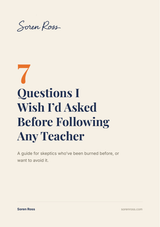
Check your inbox
A confirmation link is on its way. The guide is on the other side of it.
Nothing after a few minutes? Look in spam or promotions, or try a different address.