

Trail· The Seven Questions
How to Tell If a Spiritual Teacher Is Trustworthy: 7 Questions
The questions worth asking before you trust a teacher, a group or a teaching, and how to keep asking them once you're inside.
7 questions11 essays~2 h of reading
On this trail · 12 sections
- 1. Can I disagree with this teacher and still be welcome?
- 2. What happens to people who leave?
- 3. Is my growth measured by my experience or by my position?
- 4. Do I have full access to information, or is knowledge "reserved"?
- 5. Am I becoming more capable of thinking for myself?
- 6. How does the teacher handle being wrong?
- 7. Would I recommend this to someone I love?
- Asking them again once you're inside
- Before you judge the teacher
- Where this page stops
- The Seven Questions, layer by layer
- Questions this trail answers
A trustworthy teacher leaves you more able to think without them. Everything else, the warmth, the presence, the depth of the talks, can be real in a teacher who is quietly making you smaller. The seven questions below help you see whether a teacher is making you more able to think without them, and none of them needs inside information. You answer them from what you can see.
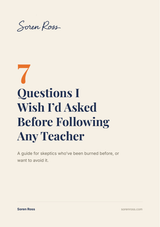
I didn't ask any of them during the seven years I spent in an organization that turned out to be cult-like, and I would have answered most of them wrong if someone had asked me. Later I practiced for more than twenty years in a tradition that welcomed questions, and for a stretch I was an instructor myself, so I've seen these questions from both sides of the room. They're the questions in the free guide; the guide adds the specific warning signs and good signs for each one.
1. Can I disagree with this teacher and still be welcome?
In the first organization, disagreement wasn't a position you could hold. There was understanding, and there was not understanding yet, so anyone who disagreed simply hadn't reached the level where it would make sense. Questioning something meant your consciousness needed work. A healthy room has space for a dissent that stays in the room. If disagreeing with your teacher feels like disloyalty, that feeling is information, and it's worth more than any explanation you're given for it.
2. What happens to people who leave?
Listen to how a group talks about the people who walked out. Ours had a phrase for it: stepping out meant walking into the lion's den, and a few times a year someone would update the story of a former member who was now said to be miserable, sick or lost. A group that needs its ex-members to be cautionary tales is telling you what it thinks of the door. In a healthier place, leaving is treated as an ordinary decision. Whether the people you know can leave without being explained away says more about the group than anything it says about itself.
3. Is my growth measured by my experience or by my position?
For a while I took my place in the organization as a sign of progress. I was trusted with more, included in more, closer to the center. I thought the group was recognizing my spiritual development. It was recognizing my utility, and what we called advancement was mostly becoming more invested. The test is whether you'd describe your growth in terms of what changed in you or in terms of where you now stand. Watch for it in yourself too. Devotion to a practice can turn into devotion to a position surprisingly fast, even among volunteers with no official ranks at all.
4. Do I have full access to information, or is knowledge "reserved"?
The practice I was given at the start was presented as simple. Then, a few weeks in, I learned there were elements I'd missed, each with consequences I couldn't check, and none of it felt like a demand. It felt like a beginner finally being let in on the details. The list never closed; there was always one more thing I hadn't done correctly yet. A group that releases its basic terms in stages, after you've committed, has decided what you're allowed to know before you agreed to anything. Ask what the next level costs, in money and in time, before you're standing on it.
5. Am I becoming more capable of thinking for myself?
This is the question the other six serve. If someone had asked me during those years whether I was thinking for myself, I would have said yes and meant it. The evidence pointed the other way. Once, in front of a room, a teacher congratulated me for turning down something nobody had offered me yet, and I went along with the decision he had just made for me. A good teacher works in the opposite direction: they want you to outgrow your need for them. So look at the small decisions. Are you making more of them yourself than you did a year ago, or fewer?
6. How does the teacher handle being wrong?
None of my essays has the scene this question asks for, a teacher caught in a mistake and owning it. What I can describe is the opposite arrangement: in a system built so that every success belongs to the method and every failure belongs to you, the teacher can't be wrong by design. Ask the simple version out loud: is there anyone here who would tell the teacher they're wrong, and has it ever happened?
7. Would I recommend this to someone I love?
I didn't ask this one either. Later, my mother told me how much she had suffered during that period, watching me disappear into something she didn't understand and couldn't reach. She had been running the test the whole time, from outside, without a name for it. If you'd hesitate to send someone you love, especially someone vulnerable, into the room you sit in every week, take the hesitation seriously. It has usually noticed something you haven't put into words yet.
Asking them again once you're inside
The answers change. A group can pass all seven the year you join and fail three of them five years later, after it has grown, or after you have, and by then you're the one with the most reasons not to notice. I saw the warning signs clearly and stayed about six months anyway, so I no longer trust a single check. About once a month I run a short test of my own on whatever I'm committed to at the time; its first question is nearly the first one here, with "respect" where this one says "welcome". It takes a few minutes, and the uncomfortable answers are the useful ones.
Before you judge the teacher
Two warnings that point the other way. First, the questions are about how a teacher and a group behave, not about how they look. I once closed a video within a second because the speaker looked old and tired, and I once judged a teacher's credentials by the furniture in his house. Both times I was answering a question nobody had asked. Second, checking can become its own trap. Verification is good for outside facts; turned on your own decisions, it can become a way of never making one.
Where this page stops
These questions are for staying awake while you follow someone, or while you decide whether to. They won't diagnose a group for you, and three or more uncomfortable answers aren't proof of anything on their own. They're a reason to look closer. If you've already left a group and the questions are still echoing, the trail Life After Leaving a Cult picks up from there.
The Seven Questions, layer by layer
The Seven Questions
Disagreement
Can I disagree with this teacher and still be welcome?

Start with this
The Fanaticism Test
I run this test regularly like antivirus software for the soul: Can I disagree with my teacher and still respect them? Can I question the system and still practice within it?

Leaving
What happens to people who leave?

Start with this
How I Left a Spiritual Community Without Becoming Bitter
Twenty-five years after walking out of a spiritual community that turned out to be a cult, the two traps that catch most ex-members, and what I kept on the way through.

Position
Is my growth measured by my experience or by my position?

Start with this
What Seven Years in a Spiritual Organization Taught Me (And What It Took to Leave)
The funny thing about cults is that nobody inside calls them that. I was twenty-something, European, and convinced I had found something real. Seven years later, I walked out.

Access
Do I have full access to information, or is knowledge "reserved"?

Start with this
The Cult Doesn't Need a Guru Anymore
The robes are the easy part to see, which is why they matter least. Take them off and the machine still runs, lately into something that never disagrees with me.

Thinking
Am I becoming more capable of thinking for myself?

Start with this
What Your Guru Forgot to Tell You
Your teacher probably told you to verify everything. Most people nod, then spend decades trusting instead. Verification is easier to say than to do.


Being wrong
How does the teacher handle being wrong?

Start with this
What Nobody Tells You About Spiritual Organizations
Spiritual organizations are still organizations. That obvious fact has implications nobody talks about. Including the slow drift from mission to maintenance.

Someone you love
Would I recommend this to someone I love?
Start with this
What Seven Years in a Spiritual Organization Taught Me (And What It Took to Leave)
The funny thing about cults is that nobody inside calls them that. I was twenty-something, European, and convinced I had found something real. Seven years later, I walked out.
Disagreement
Can I disagree with this teacher and still be welcome?
- Start with thisThe Fanaticism TestI run this test regularly like antivirus software for the soul: Can I disagree with my teacher and still respect them? Can I question the system and still practice within it?
- When You See the Red Flags but StayI spent seven years in a spiritual organization. The last six months, I saw what was happening and stayed anyway. The staying wasn't passive. It was a choice I made every morning.
Leaving
What happens to people who leave?
- Start with thisHow I Left a Spiritual Community Without Becoming BitterTwenty-five years after walking out of a spiritual community that turned out to be a cult, the two traps that catch most ex-members, and what I kept on the way through.
- What Nobody Tells You About Spiritual OrganizationsSpiritual organizations are still organizations. That obvious fact has implications nobody talks about. Including the slow drift from mission to maintenance.
Position
Is my growth measured by my experience or by my position?
- Start with thisWhat Seven Years in a Spiritual Organization Taught Me (And What It Took to Leave)The funny thing about cults is that nobody inside calls them that. I was twenty-something, European, and convinced I had found something real. Seven years later, I walked out.
- Twenty Years of Meditation: What Changed (And What Didn't)After 20 years of meditation and 7 in a spiritual organization, here's what actually changed - and what didn't. No transformation story. Just honest inventory.
Access
Do I have full access to information, or is knowledge "reserved"?
- Start with thisThe Cult Doesn't Need a Guru AnymoreThe robes are the easy part to see, which is why they matter least. Take them off and the machine still runs, lately into something that never disagrees with me.
- Nothing to ContradictI translated texts that could not lose, carefully, for a few hundred people. One question would have shown me what I was smoothing. It works on a weather forecast.
Thinking
Am I becoming more capable of thinking for myself?
- Start with thisWhat Your Guru Forgot to Tell YouYour teacher probably told you to verify everything. Most people nod, then spend decades trusting instead. Verification is easier to say than to do.
- I Am The Foundation: Why I Stopped Looking for Answers Outside MyselfAfter thirty-two years in two different spiritual systems, the most important thing I learned: you are the only foundation that can't be taken away.
- I Gave Up a Relationship for a Spiritual Path. Except I Never Chose To.The last time I saw her, we were both passengers. Twenty-six years later, a film scene and a regret study helped me name what happened at that roundabout.
Being wrong
How does the teacher handle being wrong?
- Start with thisWhat Nobody Tells You About Spiritual OrganizationsSpiritual organizations are still organizations. That obvious fact has implications nobody talks about. Including the slow drift from mission to maintenance.
- The Cult Doesn't Need a Guru AnymoreThe robes are the easy part to see, which is why they matter least. Take them off and the machine still runs, lately into something that never disagrees with me.
Someone you love
Would I recommend this to someone I love?
- Start with thisWhat Seven Years in a Spiritual Organization Taught Me (And What It Took to Leave)The funny thing about cults is that nobody inside calls them that. I was twenty-something, European, and convinced I had found something real. Seven years later, I walked out.
Questions this trail answers
- Am I judging the teacher by the wrong things?When the Messenger Ruins the Message
- When does checking turn into putting off a decision?I Learned to Verify Everything. Then I Got Stuck.
- Why does a reading or a retreat feel so convincing?Astrology Works. Not the Way You Think.The Version of You That Only Works at Retreats
- Do I need a teacher at all?I Am The Foundation: Why I Stopped Looking for Answers Outside MyselfYou Don't Need Another Book (You Need to Start)
Check your inbox
A confirmation link is on its way. The guide is on the other side of it.
Nothing after a few minutes? Look in spam or promotions, or try a different address.