The Vacant Post
For twenty years I was the man a spiritual community couldn't run without. Now I'm leaving the post, and the reflex that built it is already interviewing.

What do you do with a job nobody hired you for, nobody can fire you from, and nobody will ever advertise as vacant, once you decide to leave it?
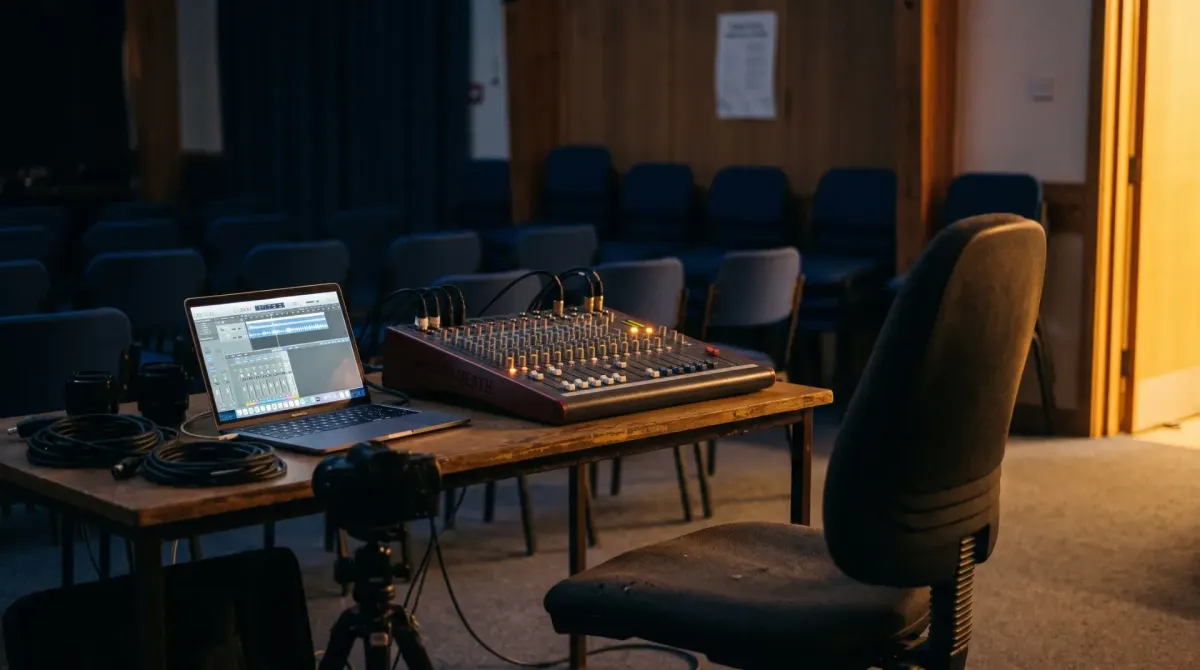
I'm asking because I'm in the middle of leaving one. For twenty years I held a post inside a spiritual community. Nothing official. I was the man who makes things run: the posters, the programs, the videos, the sound, the hundred small competencies that turn a group of people with shared beliefs into something that functions on a Saturday. If you've ever been the one your group can't run without, you know the post. This is what leaving it looks like from the inside; I'm writing from the gap, not from the far side of it.
It's not my first exit. The first time I left a spiritual community, decades ago, there was drama worth its own account. This time nobody did anything wrong, which is the harder version to write about.
The contract
I didn't choose the arrangement at the beginning. I found it already running, the way you find your native language already installed. But I did choose it later. Somewhere in my twenties I noticed that other people lived differently, reviewed the options the way an adult reviews terms, and re-signed. Whatever else this is, it isn't something that was done to me.
The terms were never written down; the math was simple enough without them. I produce things, the community keeps a place for me. My seat was paid in output.
Nobody questioned the deal for twenty years, me least of all, because it kept paying. People can find your personality tiring or your opinions wrong; a printed poster and a working sound system are harder to argue with, and nobody rejects them on taste. And there was a quieter benefit. The man who makes things run is never asked who he is. For years I filed that under the costs of the role, which took some effort, given how much I liked it.
None of this works if you're mediocre, by the way; nobody keeps a seat warm for work anyone could do. The skills were real and rare enough that the strategy paid out on every single execution for two decades, and behavior that gets rewarded every time doesn't get examined. It gets load-bearing.
The community held up its end. It never built redundancy around me because I was always there, and I was always there because being the man without whom nothing runs was how I paid my dues. Neither of us is the villain here. We used each other honestly, and the contract expired anyway; nobody renegotiated it, so it just faded while still technically in force.
Three contracts, one account
The exit has been slow, which surprised me. I expected a door; I got a series of loosening knots. I kept calling it one relationship because that was easier. It was three, and they pulled apart at different speeds: the work, the people, the beliefs. For thirty years all three had been billed through the same account, the useful one, and untangling them means finding out which were ever mine at all.
The beliefs were the easy part, oddly. They had been settling into their own shape for years before any of this. The work is what I'm giving notice on.
The people are harder.
The deposit
This summer, the community's retreat came around. Someone helping organize it walked me through the plans, warm and practical: the schedule, the poster, the promo videos. All things I usually make. And then, mid-list, casually, like a weather update: "But you're coming anyway. Your deposit's already been paid."
A friend had paid it, without asking me first or telling me after. It wasn't the first time; he gives money away whenever he has any, and he has a history of aiming it at me.
A year ago, at the previous retreat, this same friend stood up and said that what I do should be paid. Actually paid, not the symbolic amounts that had been the custom. If we don't, he said, we're going to lose him. I laughed. Nobody else did. It was the laugh a thing gets when it's funny because it's true: I had said the same words myself, two or three times over the years, in the voice of a man who doesn't expect to be taken seriously, and each time the moment had been gotten past. Now someone was saying them seriously, on my behalf, and the man with the most to gain treated it as a joke. By the end of that retreat, seeing how little money had come in, he lowered the amount himself. The idea was ratified and shrunk inside the same week.
So when I say he paid my deposit to make sure the rupture doesn't come yet, I'm not guessing. He saw this exit coming a year before I could name it. The deposit is something more than generosity: it's a hand holding open a door I've been slowly, politely closing.
If I don't go, and I probably won't, I owe him a phone call. Not a transfer with a tasteful note, not a message routed through the organizers: a call, to him. I haven't made it yet. I've been impressed by how many correct procedures I can imagine instead of dialing: the refund routed discreetly through a third person, the message so well written that no conversation would be needed after it. Thirty years of competence, volunteering for one more job.
The list
When the scenarios multiplied and I stopped trusting my own reading of them, I did what I've done for thirty years: I opened the journal. There used to be a person I could think out loud with; these days the page gets the whole conversation. I wrote down what I am now, what I'm choosing, what the new life contains. Then I started a list of what it's missing. Perspective, I wrote. Meaningful friendships. And then, in my own handwriting: maybe a group to join, where I'd have something to do. That legendary usefulness of mine, out interviewing already.
I read the sentence twice.
The post had been vacant for about a month, and the reflex that built it was already screening candidates for the next employer.
Helen Rose Fuchs Ebaugh spent years studying exactly this. A sociologist who had left the convent herself, she interviewed ex-nuns, ex-convicts, divorced people, mothers who had lost custody, anyone whose central role had ended, for a book called Becoming an Ex.1 The role, she found, doesn't stop at the exit. People keep addressing the person you were, and something in you keeps answering on that person's behalf. She called what's left the hangover identity. Mine answers in handwriting. She also mapped the exit into stages: first doubts, then a search for alternatives, then a turning point, then the long work of building an ex. By her map, the deposit was probably my turning point. This is the stretch after it.
So instead of finding the reflex its next position, the work now is to leave the post vacant long enough to find out what I am when nobody needs me. I'd like to report that this feels wise and spacious. Mostly it feels like nothing.
What I don't know yet
The days are flat in a way I have no history with. The morning sit still happens, and the page. But the phone has gone quiet the way it does when nothing depends on you, and the hours it used to organize don't ask for anything now. Nothing is wrong, and nothing pulls. Some mornings I read the flatness as the destination itself, and the fear arrives on schedule: this is it?
I have two answers, and they don't like each other. Yes, this is it, in the sense that no event is coming to deliver meaning to my door, and there is no ready-made life out there waiting to enroll me. I looked. And also no, because flat is roughly what a life looks like when the old roles have died and the chosen things haven't grown yet. Withdrawal, not a diagnosis. I believe the second half on good days. I'd believe it more if I could tell which days are the good ones.
I don't know whether I can want people without needing to be needed by them. Every friendship I can point to arrived through the work. Wanting company with empty hands is a skill I have apparently never practiced.
I've also noticed I keep waiting for the new life to look promising before committing to it, which I suspect is backwards. The writing on this blog had to exist, publicly, for a while, before anything moved toward it; I have no reason to think friendship runs on friendlier rules. You move, and then the signals arrive, or they don't.
One more thing. A month in, the decision and I still argue, just less often, and I've stopped rehearsing my side in advance. That's the nearest thing to a signal I have.
The essay is not exempt
There's a distance between what I write on this blog and what I manage on any given Tuesday, and this article is written from inside that distance. A man producing a useful essay about leaving usefulness behind: I checked, and yes, something in me is logging your attention as a form of membership right now. The man who catches the pattern makes a flattering story too, and I've been paid in that coin before. I don't think I'm fooled this time. Then again, I usually don't.
So the post stays vacant, for now. The retreat will happen without me, probably. The call to my friend still has to be made by the version of me that doesn't route things through procedures, and I'm not entirely sure he exists yet. That's the honest state of it.
Keep Exploring
If this resonated, you might also find value in:
- How I Left a Spiritual Community Without Becoming Bitter — the first exit, twenty-five years before this one: the two traps that catch ex-members, and what survives because it never needed the system.
- What Nobody Tells You About Spiritual Organizations — how status and quiet competition operate inside groups that officially have neither.
- The Seven Years — the full account of the first organization, for the context this essay deliberately skips.
Before You Apply
I'm a month into not knowing what to do with my own post. The question I keep writing down anyway, in case it's yours too: what exactly are you being paid in? And if the payment stopped tomorrow, would you still show up?
Essays for people who are harder to replace than they should be
I write about practice, discernment, and what's left of a person when the roles stop fitting. Nothing here needs you to run it. A post nobody can fill rarely invites questions about itself. 7 Questions Before Following Any Teacher, free, and one essay most Tuesdays.
One email a week. Unsubscribe anytime.
Already subscribed? Send this one to the person everyone assumes is coming anyway. They'll know what it means.
Notes & References
- Ebaugh, H. R. F. (1988) — Becoming an Ex: The Process of Role Exit. University of Chicago Press. ↩
Frequently asked questions
What is role exit?
Role exit is sociologist Helen Rose Fuchs Ebaugh's term for the process of leaving a role that has become central to your identity. Her research found the old role rarely ends at the formal exit: people keep treating you as the person you were, and part of you keeps responding as that person. She called this the hangover identity.
Why is leaving a volunteer role in a community so hard?
Because the role is rarely just work. Long-term volunteering often becomes the way a person belongs to the group, so stopping the work can feel like losing membership, not just changing tasks. The two have to be untangled separately.
Why do some people become indispensable in groups?
It's usually built from both sides. The group stops building redundancy around someone who is always there, and the person keeps showing up because being needed feels like belonging. Neither side plans it; the arrangement simply gets reinforced every time it works.
Is it normal to feel flat after leaving a long-held role?
Yes. A period of flatness is common when an old role has ended and new commitments haven't grown yet. It tends to look like absence of meaning, but it often behaves more like withdrawal from being needed, and it usually shifts with time and new commitments.
What's the difference between being useful and belonging?
Usefulness is a trade: you provide something, you get something back. Belonging that depends on staying useful is also a trade, just an unwritten one. A workable test is to ask what would remain of your place in the group if you stopped producing tomorrow.