The Authenticity Trap (Why "Being Yourself" Is Harder Than It Sounds)
The moment you try to be authentic, are you still? Social media didn't create the performance. It just made the audience permanent.

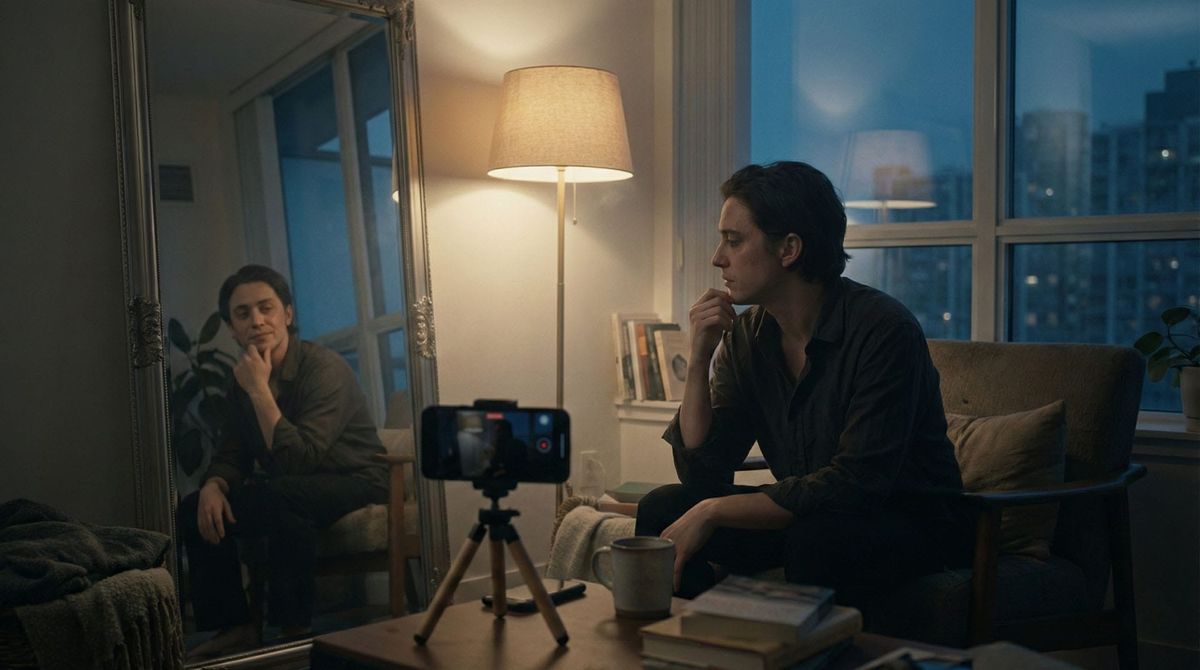
A question that keeps me up at night: the moment you try to be authentic, are you still being authentic?
Think about it. You're at a dinner party, and someone says something you disagree with. You pause. You consider your response. You think: what would the authentic version of me say here?
And right there - in that pause, in that consideration - you've already stepped out of being yourself and into performing yourself. You're now directing a play about who you are rather than simply being who you are.
I've watched this paradox play out for thirty-two years, in myself and in others. And I've come to a conclusion that's either liberating or unsettling, depending on how you look at it.
The Performance Nobody Admits
The sociologist Erving Goffman had a phrase that haunts me: life as theater1.
His basic insight was this: in every social interaction, we're performing. Not performing in the sense of lying - performing in the sense of managing impressions. We adjust our language, our tone, our body posture, our level of formality depending on who we're with and what we want them to think of us.
With your boss, you're one version. With your friends, another. With your parents, another still. With a romantic partner, yet another. Same person, different performances.
Most of us do this unconsciously. It's not deception - it's adaptation. It's how humans move through complex social environments. We've been doing it for thousands of years.
The problem starts when someone tells you to "just be yourself."
Because which self? The one that appears at work? The one that emerges with close friends? The one that shows up at 3 AM when you can't sleep and the internal monologue gets uncomfortably honest?
"Be yourself" implies there's a singular, stable self to be. But what if the self is more like water - taking the shape of whatever container it's poured into?
"'Just be yourself' is great advice if you have only one self. The rest of us are running a casting call."
When Authenticity Became a Strategy
I remember the exact moment I realized something had gone wrong with how we talk about authenticity.
I was scrolling through LinkedIn - already a red flag - and I saw a post from someone explaining how to "build an authentic personal brand." The post offered seven steps for appearing genuine. Strategies for seeming real. A methodology for manufacturing spontaneity.
I read it twice, wondering if it was satire.
It wasn't.
This is what happens when authenticity becomes valuable: it gets packaged and sold back to us as a technique. The genuine article becomes a performance of genuine-ness. The thing that was supposed to free us from performance becomes just another, more sophisticated performance. (I wrote more about this dynamic in The Lie Self-Help Keeps Telling You - how the industry profits from keeping you searching.)
I spent years in spiritual communities where this dynamic was epidemic. Everyone was performing non-attachment. Performing presence. Performing enlightened acceptance. The people who seemed most peaceful were often just best at the performance - which I know because behind closed doors, some of them were anything but peaceful.
I was no different. I got very good at seeming serene. I had the meditation posture. The calm voice. The spiritual vocabulary. I could perform "evolved" with the best of them.
The problem was, I wasn't particularly evolved. I was just well-rehearsed.
"I spent years perfecting my spiritual image. Turns out 'enlightened' is easier to act than to actually become. The acting part just requires practice. The becoming part requires honesty - which is much less photogenic."
The Observer Effect
Physics has this concept called the observer effect: the act of observation changes what's being observed. You can't measure certain things without affecting them. The measurement and the thing measured become entangled.
Something similar happens with authenticity.
The moment you become aware that you're being watched - or even might be watched - you stop being purely yourself and start being yourself-for-an-audience. Not necessarily a fake self. Not necessarily a dishonest self. But an adjusted self. An edited self. A self that's been run through the filter of "how will this be perceived?"
Research backs this up. Studies show that people behave differently when they know they're being observed - even when the observation is minimal2. We become more prosocial, more careful, more... self-selected.
This wasn't much of a problem for most of human history. You were observed by your immediate community, and that was it. Your audience was limited. The rest of the time, you could just be.
Then came the internet. Then came social media. And suddenly, we're all performing for an infinite potential audience, all the time.
The Always-On Stage
What changed, and I don't think we've fully reckoned with it yet:
We used to have distinct zones. Public life and private life. Performance spaces and recovery spaces. Times when you were "on" and times when you could just exist without an audience.
Social media erased those boundaries.
Now, every moment is potentially content. Every experience is potentially shareable. Every thought could become a post. And even when you're not actively sharing, you're often unconsciously framing your life as if you might.
I catch myself doing this. Something interesting happens, and before I've finished experiencing it, I'm already composing how I'd describe it. The living and the narrating have become simultaneous. I'm not just having a life - I'm editing the story of having a life, in real-time, for an audience that may or may not be watching. This connects to why I chose anonymity for this project - the freedom to write without auditioning for approval.
This is exhausting. And I think it's why so many people feel a strange kind of hollowness, even when their lives look good on paper - or on screen.
When you're always performing, you lose access to the non-performing parts of yourself. The parts that emerge only in unobserved moments. The parts that don't have language yet. The parts that just are without needing to be communicated.
"Social media didn't create the performance. It just made the stage omnipresent. Now we're method actors who forgot we ever knew how to break character."
The Authenticity Industrial Complex
And this is where it gets weird: the solution being sold is more of the problem.
The self-help industry noticed that people feel disconnected from themselves. So it created products to help you "find your authentic self." Books, courses, retreats, coaches - all offering to help you discover who you really are.
But here's the catch: the process of working on your authenticity is, itself, another form of self-improvement project. Another performance. Another thing you're doing to become a better version of yourself for... someone. Some audience. Some standard.
I've done these exercises. I've journaled about my "true self." I've made lists of my values. I've sat in workshops where we talked about authenticity for hours while performing for each other the entire time. What was I expecting? That if I journaled hard enough, my "true self" would appear like a genie? Self-improvement has an entire industry built around becoming more yourself. The paradox rarely makes the brochure.
The irony never quite landed until recently: you can't technique your way to authenticity. The moment you approach it as a project - something to achieve, something to optimize - you've already missed the point.
Authenticity isn't something you build. It's something you stop blocking.
What Gets in the Way
So if authenticity isn't a destination you reach through effort, what is it?
My working theory, after three decades of elaborate wrong turns: authenticity isn't about finding your true self. It's about noticing what you're adding to it.
Every time you adjust your opinion because you're worried about how it'll land. Every time you suppress a reaction because it might make you look bad. Every time you perform interest you don't feel, or hide interest you do feel, or present yourself as slightly different than you are in this moment - that's not inauthenticity, exactly. That's normal human social behavior.
But it accumulates. And at some point, the accumulation becomes so thick that you lose track of what's underneath. You've been performing so long, you've forgotten there was ever anything else.
The path back isn't about becoming more authentic. It's about performing less. Curating less. Editing less. Not as a new performance ("look how unedited I am!"), but as a gradual relaxation of the grip.
"I spent years trying to build an authentic self. Then I realized I already had one - I'd just buried it under thirty-two years of trying to be acceptable."
The Paradox You Can't Solve
The thing is I've made peace with, uncomfortably:
You can't fully escape the paradox. The moment you're aware of yourself, you're already in some sense observing yourself. And observation changes what's observed.
Trying to be perfectly, purely authentic - with no performance, no adjustment, no social consideration whatsoever - isn't enlightenment. It's a different kind of fantasy. Actually living that way would make you unemployable, unpartnerable, and probably unbearable at dinner parties.
Some degree of performance is just what living in society requires. The question isn't how to eliminate it entirely, but how to keep it from consuming everything.
Research on self-monitoring - the degree to which people adjust their behavior based on social cues - suggests that both extremes are problematic3. High self-monitors are so adaptable they can lose their sense of self. Low self-monitors are so consistent they're often socially ineffective. The healthiest approach seems to be somewhere in the middle: adjusting when appropriate while maintaining a stable core.
Performance can't be eliminated. The work is knowing when you're doing it and choosing it consciously, rather than performing so automatically that you forget you're doing it at all.
What Helped (Eventually)
I don't have a five-step solution for you. If I did, it would just be another technique, another thing to add to the performance. Besides, my track record with five-step solutions is... well. Let's just say the steps usually multiply.
But I can tell you what helped me, after years of circling the same drain:
Less audience. I deliberately reduced how much of my life I share publicly. Not because sharing is bad, but because I'd lost the ability to experience things without framing them for consumption. Last month, I went somewhere beautiful and didn't tell anyone. Didn't photograph it. Didn't compose the caption in my head. It felt strange at first - almost like it hadn't happened. The practice of having experiences that are only mine - that will never become content - has been unexpectedly healing.
More unobserved time. I spend more time alone than I used to. Not lonely alone - intentionally alone. Time without any audience, real or imagined. Time where there's no one to perform for, so the performance can gradually wind down.
Noticing the edits. I started paying attention to the moments when I adjust myself. Not to stop doing it - that would be yet another project - but just to notice. Oh, I just softened that opinion because I was worried about the reaction. Oh, I just presented myself as more certain than I am. Just noticing. The noticing itself creates space.
Letting imperfection be visible. This one's hard. But I've started letting people see me when I'm not at my best. When I'm confused, uncertain, having a bad day, being less than impressive. Not performed vulnerability - just regular, unglamorous, not-ready-for-an-audience reality.
It's uncomfortable. It doesn't make for good content. But it's closer to something true.
The Only Instruction That Matters
The writer Anne Lamott has this line I keep coming back to: "Lighthouses don't go running all over an island looking for boats to save; they just stand there shining4."
I think that's the closest thing to an instruction I can offer about authenticity.
Stop trying to be authentic. Stop working on your authenticity. Stop optimizing your genuine-ness.
Just... stand there. Shine with whatever light you have, even if it's flickering and uncertain. Let people see it or not. Let it be enough or not.
The performance is exhausting because it requires constant effort - constant monitoring, constant adjustment, constant maintenance. The alternative is performing less hard, not performing better.
This doesn't mean you'll stop adapting to social situations. You will. You're human. But there's a difference between adapting and disappearing. Between adjusting and forgetting who you were before the adjustments.
"The goal isn't to be yourself at everyone. The goal is to not forget who you are while being with everyone else."
Keep Exploring
If this resonated, you might also find value in:
- Why I Don't Want to Be Famous — On choosing impact over visibility, and the freedom of working without an audience.
- The Lie Self-Help Keeps Telling You — The $50 billion industry that profits when you keep searching instead of finding.
For You
If you've ever felt the strange exhaustion of performing even when no one's watching - of curating your life for an audience that may not exist - I want you to know:
That's not a personal failing. That's the water we're all swimming in.
But you can swim differently.
You can have experiences that never become content. You can hold opinions that never get posted. You can be uncertain, unfinished, unimpressive - and let that be okay, even if no one else sees it.
Especially if no one else sees it.
The authentic self everyone's looking for isn't hiding somewhere deep inside, waiting to be discovered through the right technique. It's right here, right now - just obscured by all the performances stacked on top of it.
You don't need to find it.
You need to stop burying it.
What If You Stopped Performing?
Weekly essays on the gap between who you are and who you perform. And on narrowing it.
Every Tuesday at 8 AM EST. One email. Unsubscribe anytime.
Already subscribed?Share this with someone who's exhausted from performing for an audience that might not even be watching.
Notes & References
- Goffman, E. (1959). The Presentation of Self in Everyday Life . Anchor Books. Goffman's dramaturgical analysis suggests that all social interaction involves impression management - we're all, in some sense, actors on a stage. ↩︎
- Bateson, M., Nettle, D., & Roberts, G. (2006). "Cues of being watched enhance cooperation in a real-world setting." Biology Letters , 2(3), 412-414. This study found that even subtle cues of observation (like images of eyes) significantly changed people's behavior. ↩︎
- Snyder, M. (1987). Public Appearances, Private Realities: The Psychology of Self-Monitoring . W.H. Freeman. Snyder's research on self-monitoring shows that both very high and very low self-monitors face distinct challenges in maintaining a coherent sense of self. ↩︎
- Lamott, A. (1994). Bird by Bird: Some Instructions on Writing and Life . Anchor Books. ↩︎